3 min read
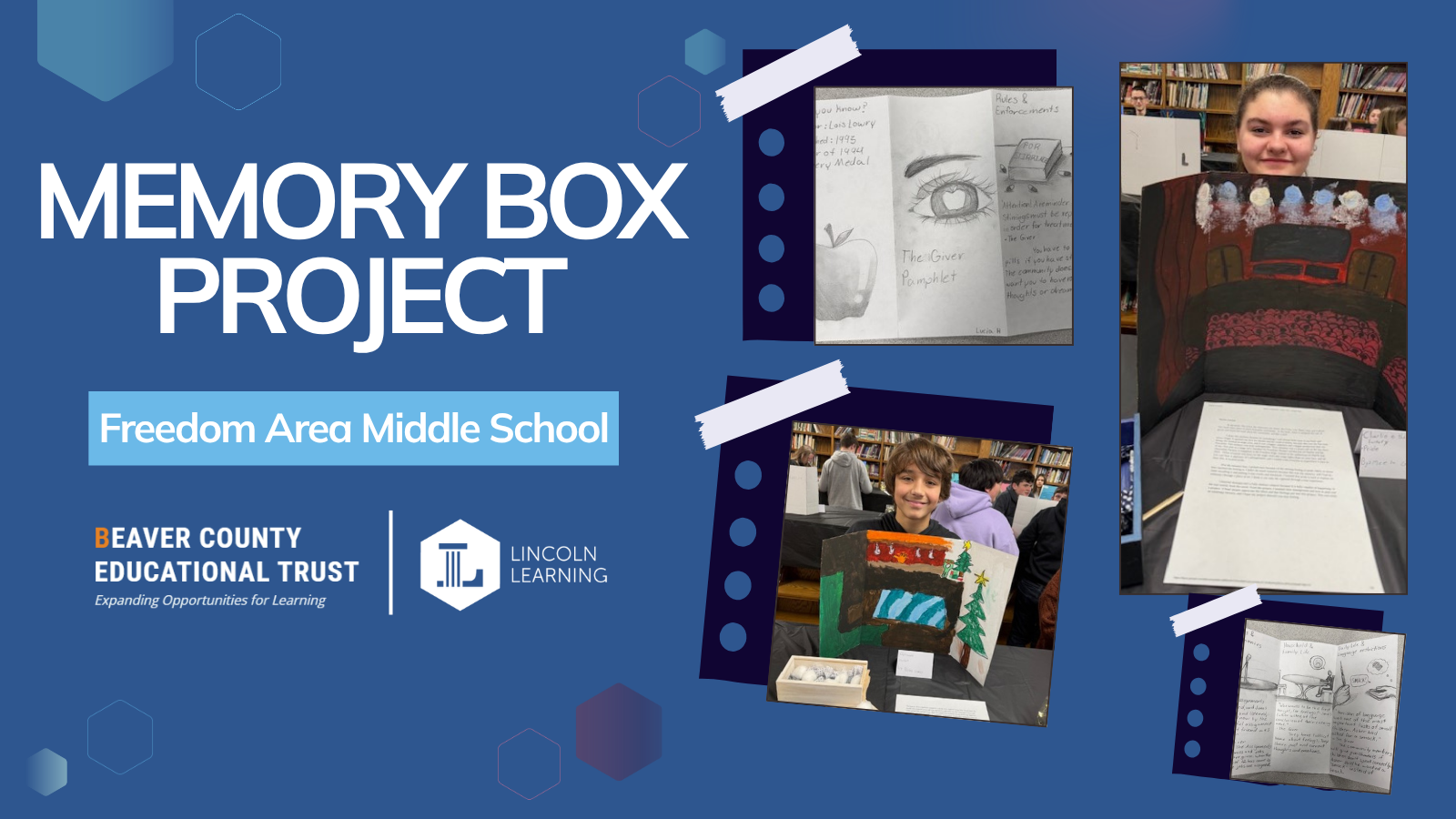
For Mackenzie Clark’s seventh-grade English language arts students at Freedom Area School District, a trip down memory lane is taking on an entirely new meaning.
As part of their unit on “The Giver” by Lois Lowry, Clark’s class created memory boxes to explore major themes of the novel, including memory, emotion, choice, and freedom — elements missing from the dystopian society depicted in the story.
Clark, a second-year teacher, said she wanted her students to experience the story from the characters’ perspective.
“I wanted our students to do more than read about memory and emotion — I wanted them to experience the contrast between compliance and freedom,” Clark said.
When Clark learned about the Beaver County Educational Trust’s Great Ideas Mini-Grant during an in-service day, she decided to apply for funding to bring the Memory Box project to life.
The Beaver County Educational Trust’s Great Ideas Mini-Grant program offers innovative and imaginative teachers opportunities to carry out projects with their students and communities that stretch educational experiences beyond the world of the everyday classroom.
According to BCET Executive Director Jamie Connelly, over its 35-year history, the program has funded 823 grant requests totaling $511,000 and reached more than 120,000 K–12 students in Beaver County. Of those funds, Lincoln Learning Solutions has donated $325,000 since its involvement in the program in December 2014.
BCET awarded Clark a $750 grant, allowing her to purchase art supplies for the project’s three creative phases.
The Pamphlet
In “The Giver,” the main character, Jonas, lives in a world without pain or conflict. The Elders achieve this peace through complete control, suppressing emotion and eliminating individual choice. When Jonas is selected to receive memories from the Giver, he begins to understand everything his community has lost under the Elders’ control.
Each student designed a pamphlet illustrating how the Elders normalize control within Jonas’ community. Clark said this part of the project helped students identify and depict how messaging and rules shape behavior in the novel.
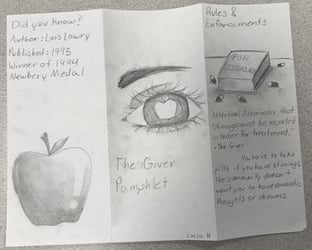
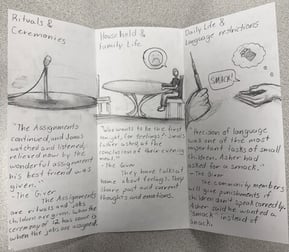
Pamphlet created by Lucia Haney
The Trifold
To experience the contrast between control and freedom in “The Giver,” students selected a meaningful personal memory connected to real emotions. Clark gave them the freedom to choose how to express that memory artistically.
Memory Boxes
In the final phase of the project, students created memory boxes filled with objects representing how their chosen memory made them feel. Clark said this phase emphasized the importance of memory and emotion throughout life, while reinforcing students’ freedom to choose what to remember and how to express those memories.
Meela Gordon based her project on the day she fell in love with theater and drama. Her trifold depicts the curtain call from the first musical production in which she worked as part of the stage crew.
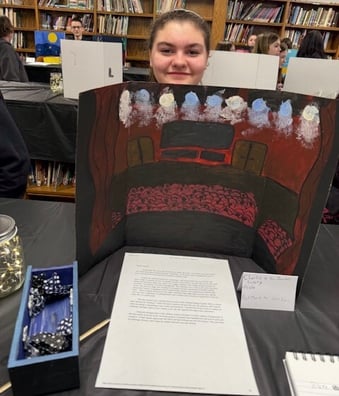 Meela Gordon
“My memory occurred during the bows onstage, when the stage lights blare in your face and all you can hear is applause,” Gordon said. “It’s unforgettable. It evoked pride.”
For her memory box, Gordon added stars to symbolize that feeling of pride. She also included fabric to represent how layered the emotion felt.
In addition to deepening her understanding of the novel, Gordon said the project strengthened her time-management and planning skills.
“It was truly an amazing memory, and I hope my project showed you that feeling,” she said.
Blake Lundy created his project based on a memory of his entire family coming together to celebrate Christmas, including his brother, who lives overseas.
“This memory represents comfort and safety,” Lundy said. “I appreciate the moments I have with family to feel comfort.”
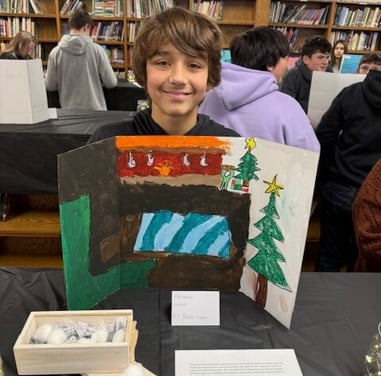 Blake Lundy
The project culminated in a gallery walk held in the middle school library, where parents, staff and community members viewed the artwork and discussed the meaning behind each piece.
Clark said the gallery walk drove home the message of “The Giver.”
“By asking questions and truly listening, visitors showed students that their voice matters — that their voice, memories, emotions, and choices are worth celebrating,” Clark said. “That’s the gift ‘The Giver’ teaches us we should never take for granted.”
Related Posts
Unified Robotics Brings Students Together
Collaboration and teamwork were the name of the game when Hopewell High School hosted its first...
Success Story: Personal Instruction
In 2016, Kitana Graham turned to PA Cyber after ongoing surgeries and extreme anxiety caused major...
Dig into Learning
Fourth graders at Hopewell Elementary School in Hopewell Township are getting their hands dirty as...